

For a migraine-friendly & printable PDF version of this article, see here.
Hi 👋🏻
My name is Elina, and I’m a Neuroscientist by training.
What exactly does that mean?
It means that I have spent the better part of a decade and a half studying the brain and nervous system.
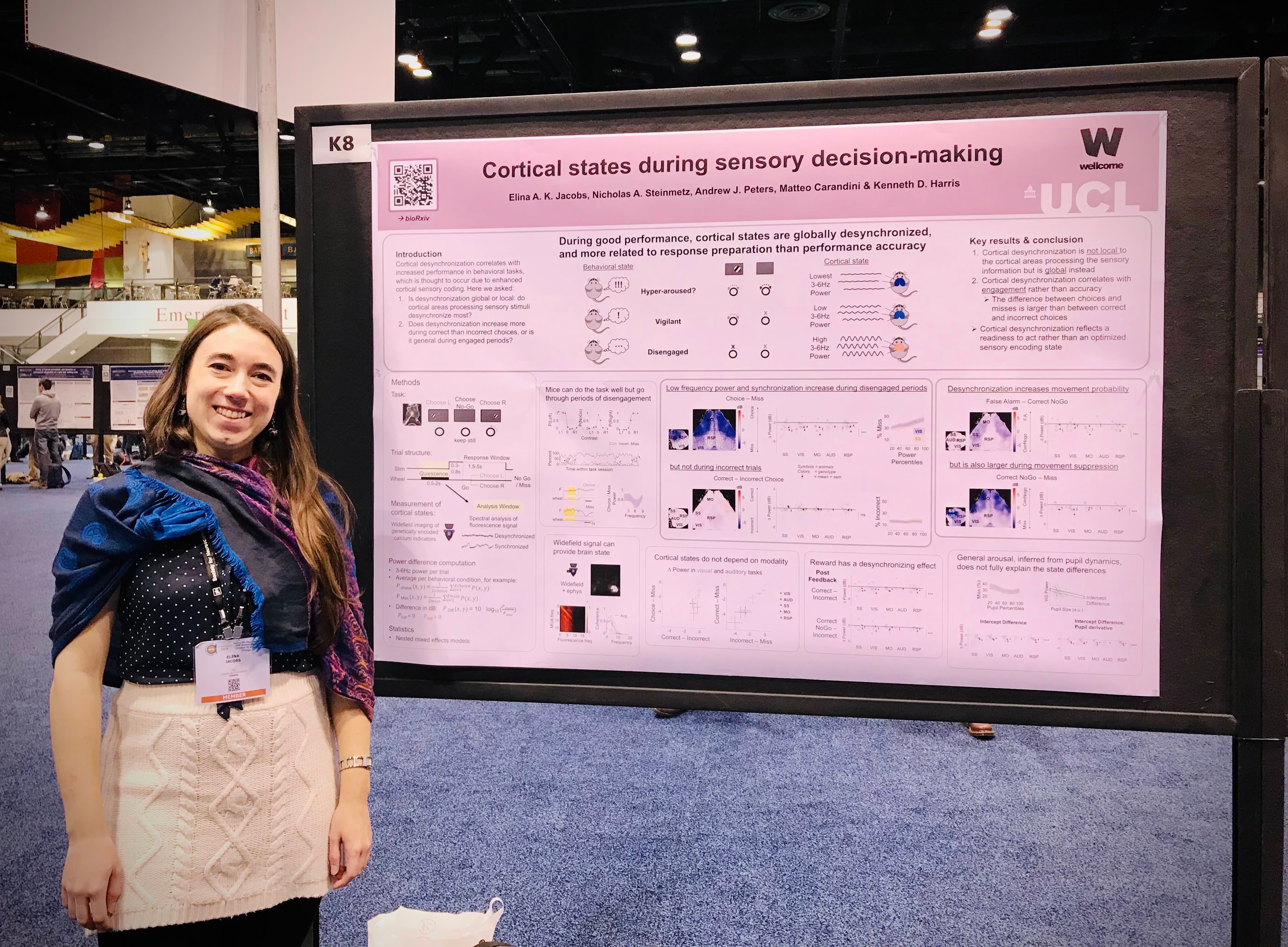
I specialised in systems neuroscience during my PhD, which I did at UCL - one of the leading neuroscience research universities in the world.
And in case you’re wondering “systems neuro- what?”, let me explain:
Systems neuroscience is one of the many subdivisions of neuroscience. Specifically, it focuses on understanding how the different parts of the brain and nervous system function together: how networks of neurons (and the many other cell types that surround them) communicate to give rise to everything - from movement and memory to perception and emotion.
During my PhD, I studied the cortex, which is the outermost layer of the brain that looks like a walnut1. I was particularly interested in the impact of neuromodulators on cortical function2, even though I did not end up studying them directly - but I’m mentioning it because it turns out this interest, and understanding cortical function, would become a lot more relevant to my personal situation than I ever imagined…
Which brings us to my migraine journey
I’ve had migraines since I was a teenager, and while they were somewhat bothersome then - occurring a few times a month - in my twenties, the situation got much better, and I was able to lead a pretty migraine-free life. I had maybe a handful of attacks a year, I knew the warning signs, would take my medication, and then get on with my life.
As I now know, this is known as “Level 1” migraine.
Then, shortly after turning 30, and coinciding with me trying to work as a postdoctoral researcher - meaning someone who has gotten their PhD and is now putting their hard-earned skills to practice in a more independent research project - I started rapidly progressing up the “migraine levels”, meaning: they quickly got worse and worse.
First, a strong dose of over-the-counter pain killers wasn’t enough anymore to stop a migraine. So I went to the doctor, and got a prescription for sumatriptan - which worked wonderfully initially, and I went back to recovering from a migraine reasonably quickly: one pill of sumatriptan and a few hours of rest, and I’d be good to go again.
But this also only lasted about 6 months or so.
I started having more and more lingering symptoms - prodromes that could last up to 10 days. I knew a migraine would be coming but I wouldn’t know exactly when, eventually an attack proper that started lasting 1-2 days, followed by another 1-2 days of postdrome (migraine hangover) until I felt like I’d recovered from it. Then, I’d have maybe a week of feeling normal - if that - and the next migraine prodrome would start. At the start of 2021, I called my doctor and told them, hey, so I’m starting to have migraines that last so long that overall I have about 20 days a month of migraine symptoms, maybe I should try a preventative medication? And from there, things went downhill, very fast.
I spent a year going to different doctors, trying different medications, reacting horribly to them, trying to figure out what was going on, all the while the pandemic was still raging, and the pressure was on as a postdoc in a highly competitive science environment, trying to get some work done.
I had no idea that what was actually happening was that as I “levelled up” in migraine severity, I was becoming more and more disabled - so I tried desperately to keep up with my previous working practices whilst increasingly getting stressed about how much work got lost to me hiding in dark rooms, trying to cope with pain that didn’t want to go away.
You know what the irony here is?
The postdoctoral research project that I was trying to get off the ground was about how stress - in particular early life stress - impacts the development of neural circuits involved in arousal; the very neuromodulatory circuits that I’d been so interested in during my PhD as well.
Again, little did I know how relevant the impact of stress and neuromodulators going a bit haywire was to my own brain, as I was going down the path towards…
Chronic migraine
In early 2022, I finally bit the bullet and decided to pay privately for an appointment with a neurologist who specialises in migraines. I was stunned to realise that not only did I squarely qualify for a chronic migraine diagnosis, I also scored three times the minimum score for severely disabled.
Severely disabled.
No wonder everything felt so… impossible.
And so began a long an arduous journey… of figuring out how to try and get my very own brain health back.
At this point, I’d reached “Level 5” which involves something called ‘central desensitisation’3 - when absolutely everything hurts, and your life revolves around trying to manage triggers and pain.4
I knew from previous experience that the best way for me to deal with life throwing me a majour curve ball was to try and find - or rather, create - meaning in suffering. Which brings me to this very endeavour.
I realised I had one ace up my sleeve - and that’s my neuroscience training. Any time I could, I dug into the science about what we know about migraines. I wanted to understand what was happening to me, my brain, my body.
Through that journey I realised that there is a lot of research that has shed new light on this neurological condition in the last two decades, but most of it is buried in the depths of academic papers, inaccessible to the people who need it most.
The more I understood about migraines, the more empowered I felt - and that’s where I found the meaning: I knew I’d want to be part of the mission to destigmatise migraine, and put the much-needed understanding of what they are into the hands of those who need it most.
That’s why I’m launching this Substack:
To turn the things I learned about into actionable insights, without the jargon, so anyone can apply a little neuroscience in their every-day lives to help themselves live better with migraine.
Let’s talk a little bit more about my skills…
First, what I am not
I am not a neurosurgeon. I’m not entirely sure why, but I get asked reasonably regularly whether being a neuroscientist means that I do brain surgeries - no, I do not.5 That’s the job of neurosurgeons, and I am not one.
I am not a medical doctor, and therefore, I am not a neurologist. All content here is meant to be educational only - a basis from which you can have informed conversations with your healthcare providers. Do not under any circumstance take any of what I have written or shared here as medical advice, and act on it without going over whether it is suitable for you with your doctor!
I am not a physiotherapist. I am quite nerdy about anatomy and physiology, but that doesn’t mean I know how to “fix” problems relating to those. My yoga teacher training included how to keep people with injuries and medical problems safe in their practice, but this is still a far-cry from what someone trained to deal with these problems can offer.
I am also not an active migraine researcher. I’ll explain the pros and cons of this below - but first, let’s get to:
What I am
A neuroscientist who’s been trained by some of the leaders in the field, in one of the top places in the world for neuroscience.6
Someone who can read the research at its source, in the neuroscience and neurology literature, and make sense of it.
And because I also live with migraine myself, I can cut to the chase and figure out which bits are the most useful for migraine management. Sometimes, not being directly in the trenches means being able to see the forest for the trees - not getting lost in interesting but irrelevant details, instead focusing on what matters for practicalities.
I am someone who can interpret the science not just through a scientist’s lens, but also from lived experience.
Here’s what I want to be upfront about though: being a neuroscientist alone does not make me an expert on migraines. I have read a lot of the research since my diagnosis, but there are things that can’t be gleamed from reading papers, they can only be learned while ‘in the trenches’ of doing the actual research. This means there will be potential pitfalls and caveats to the research that I won’t be able to spot.
Why am I telling you this?
First, I think it’s important to be honest, and also because this touches on an inherent aspect of science and research: it’s ever-evolving. While there is a lot we have learned that I think is worth knowing as a migraineur, we are still far from final, definitive answers. There may well be things that I share here that end up being wrong.7
I know this might all sound a bit confusing.
Why share any of this if science is messy and evolving? Well, because I’d say waiting for perfect knowledge risks staying in the dark forever. My goal here is to take the best of what we currently know and translate it into insights you can apply and use in your day-to-day life. I’ll be upfront about which bits we’re fairly certain about, when the research is still murky, or when I’m making educated guesses. I’ll always let you know what you’re working with, so you can make informed decisions about what feels worth using in your own life.
Sound good?
Awesome.
In that case - hit that subscribe button, and then you’ll receive my content straight into your inbox, and never miss a thing.
And one last thing - about that content:
I’ll create an audio-recording for each article cause I know staring at screens isn’t the most migraine-friendly activity.
I’ll make the articles available as PDF’s so if you do prefer to read, you can print them out onto paper - at least I find that reading from paper is much more bearable than on a computer or mobile phone.
I want this content to be as accessible as possible. If there is another way you can think of that would help with that - please let me know, and I’ll be glad to consider it.
For an overview post of what exactly I’m building here, see here:

At least in humans it resembles a walnut. But not all animals have a cortex, and of those who do, not all have one that’s wrinkly.
I’ve also written a post about this on my other Substack:
I’ll break down what this means in a future post.
At least not on humans - but that’s a story for another time.
I have multiple Noble prize winners in my ‘academic lineage’ and have worked in the same institute as a current one. At the time of my PhD, UCL was the best place for Neuroscience in Europe, and second in the world only to Harvard.
If there is anything you think I got wrong, please let me know. I’ll be glad to look into it, and make any necessary corrections.
This sounds so much like my migraine journey, minus being a neuroscientist. Your timeline is very similar, and so much of it resonates with me. "...when absolutely everything hurts, and your life revolves around trying to manage triggers and pain." I'm trying so hard to be gentle with myself, yet set goals, and not be afraid that something will cause a migraine. Trying to stop thinking "what am I doing wrong?" all the time, and live my life, somehow.
Oh this is brilliant. I love all this. Bar the suffering on your side.
We really need this gap bridged. And here you are, the person to help us 🤩🤗
You will love my book even more then….possibly the most Elina😆
It has all the migraine research in there, but the kind that has been known about for many decades. We just didn’t bother to educate any one on it.
The research I’ve done, none of it is new. Of course, the deep neuro science stuff would be a bit much for my brain 😆
But I’d love to learn from you.
And I am tremendously excited to see what you make of my book.
I honestly think you’ll be one of its biggest fans.
Plus, if it floats your boat, it’ll support you in writing your own. Which is something I really wanted this book to do.