


For a migraine-friendly & printable PDF version of this article, see here.
Table of contents
What have nerves got to do with pain?
Where do pain signals come from?
Why understanding the many signals nerves carry matters for pain
How the brain creates pain
The body’s own molecules that trigger pain
Pain in the brain
How pain can get stuck
What is pain?
Unless you are one of the few individuals with a particular gene mutation who do not experience pain1, you’re probably quite familiar with what pain is and what it feels like.
But where does pain come from?
If you answered the question with, ‘pain is what you get when there is an injury’ then your answer would be in line with what most people - including physicians - used to (and often still) think is the correct one.
But you see, this is where the answer gets more complicated.
Let me take you on a little tour.
Everyone is talking about the nervous system these days…
… but do you know what an actual nerve is, or does?
Nerves are, as the name suggests, a pretty essential component of the nervous system. They’re the connection of the brain - that big wrinkly lump of fat sitting inside your skull - to the outside world. And when I mean outside world, I don’t just mean the world outside your body - I mean the world outside your brain, too.
Huh? What’s the difference?
Well, there is a world between your brain and the “outer” world, and that world is your body.
That’s right, the brain is connected to your body via nerves! Maybe you knew that, but do you know what those nerves do, beyond sending signals from your brain to your body?
The connection between the brain and the body is much more intricate than just a simple “the brain = command centre” and “nerves = executioners”.
Nerves collect all kinds of information from the body and the outside world, and send those to the brain for consideration.
As a matter of fact, at any given moment in time, your brain is literally being bombarded with information, and one of the core jobs of the brain is to figure out what to do with all of it - and what to heed attention to.
If at this point you’re wondering what all of this has to do with pain, bear with me, we’ll get there in a moment.
A single nerve contains many, many nerve cells - each of which carries a particular kind of information. And some of these nerve cells are specialised in carrying pain signals.
So where do these pain signals come from?
I’m so glad you asked.
These specialised nerve cells have special receptors: nociceptors, from the Latin nocere, which means to harm or injure, or also called pain receptors.
These come in 3 different flavours:
Mechanical nociceptors
Thermal nociceptors
Chemical nociceptors
As their names suggest, the mechanical nociceptors respond to extremes in pressure - say, when you get hit by something, rather than just touched, thermal nociceptors respond to extremes in temperature - when you scould yourself with hot water, or get a frostbite in winter, but it’s the chemical nociceptors that are the wild ones in some ways: they respond to harmful chemicals, such as poison or other corrosive materials, but here’s the kicker: they can be activaited by the body’s own molecules2.
Imagine the body as a tree for a moment. Each little branch is a nerve cell (also called neuron), that joins to a bigger branch, which is a nerve, which then joins the trunk, which is the spinal chord, which goes into the roots, where in this analogy the brain would be.
To help illustrate this point, I drew the little sketch below. I hope that clarifies what I mean:
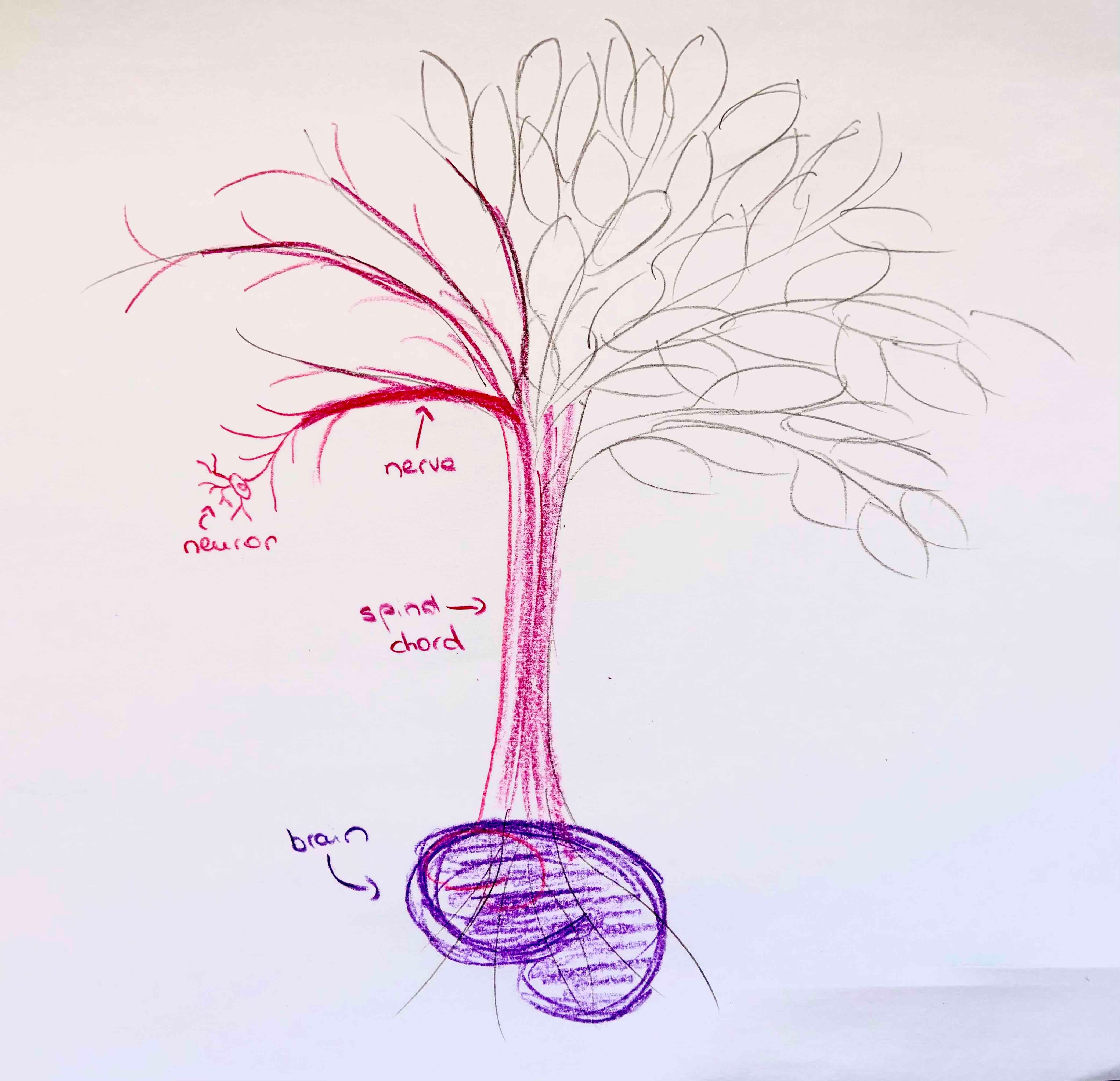
Next, imagine for a moment that this is quite an unusual little tree, for all the small branches are covered in little locks, each one requiring a very specific kind of key to unlock. But once the correct key comes in, the lock unlocks, which creates a signal that travels up the small branch to the bigger branch, then the trunk and finally the roots.
This is, roughly, how nerve conduction works. Mechanical nociceptors are like locks that “wait” for extremes of pressure as keys to unlock them, thermal nociceptors are locks that need extremes of temperature to unlock them, and chemical nociceptors are like locks that want particular chemicals and molecules for them to unlock. Once a lock is opened, each of them generates a signal that travels along the nerve to the spinal chord3 and then the brain.
But the thing is, “pain locks” are not the only kinds of locks in the body; there are many more different kinds of specialised nerve cells, each of which carries a different kind of signal to the brain.
What other kinds of signals do nerves carry to the brain?
This depends a little bit on the type of nerve - we have a lot of them throughout the body - but roughly speaking, they fall into these categories:
Proprioceptive signals: These signals come from your muscles, joints and tendons, and allow your brain to determine where your body is and how it’s moving.4
Touch: Your skin is covered in receptors that send information about touch - the texture, the intensity - to the brain. The density of receptors varies between parts of the body - you have more in your finger tips than on your back for example, which is why you can tell what is touching you with more precision on your fingers than on your back!
Temperature: These signals come from various structures, notably the skin, but also from the tongue, internal organs, and even from within the brain itself, as your body monitors not just the temperatures outside but your internal temperature as well.
Visual information: This is carried from your eyes to the brain via a specialised nerve called the optic nerve.
Sound information, carried from your cochlea - the small structure in your inner ear that detects sound - to the brain via the auditory nerve.
Balance: Your inner ear, in addition to having the structures that allow you to detect sound, has a specialised organ to detect balance as well. This information travels to the brain in the vestibular nerve.5
Signals from our internal organs:
How fast your heart is beating, how fast or slow you are breathing, how full or empty your stomach is, how digestion is going in your intestines, how much water your kidneys are filtering, how much fat is stored in your fat cells, what’s the PH in your blood, … the list goes on.
All of these signals are considered sensory signals - they allow us to sense our internal and external environment. In addition to those, nerves also carry motor signals. But those are the ones carried from the brain to the body, and while there is a lot of interesting stuff going on there too, we won’t concern ourselves with that this time. Suffice to say that most nerves are a mix of sensory and motor neurons.
What do all these other signals have to do with pain?
Here is where things get really interesting.
Remember how I said that at any given moment in time, your brain is being bombarded with information? I told you about all of these other signals so you get an idea of just how much information your brain is dealing with - and the signals from nerves don’t even cover the ones that your brain receives via hormones6. Whatever bodily function you can think of, your brain is getting a signal about it. So as you can see, your brain is dealing with a lot.
So where does pain come in here?
Pain, in many ways, is “just” another signal that gets sent from our bodies to the brain. What your brain does - constantly - is keep track of all the information that’s coming in through the nerves, and uses that to:
Decide what is the most relevant and important right now, so it can direct your conscious attention to it.
This latter part is critical, because as we will see, any of these pain receptors being “unlocked” is not actually enough to generate pain -
THE BRAIN CREATES PAIN BY ‘CHOOSING’ WHAT THE MOST RELEVANT INFORMATION IS.
And if the brain deems the unlocking of the pain receptors as not the most urgent issue at hand, you will not feel any pain, and may not even notice an injury.
Here’s a querky little linguistic detail about the scientific name of these pain receptors, nociceptors: ‘noci’ comes from the Latin nocere, which means to harm - so these locks unlock when there is something that is potentially harmful. But at this stage, there is no pain yet.
Let’s illustrate this with an example.
Imagine a marathon runner. Imagine how focused they are on the task at hand - get to that finish line, maybe beat a personal record, do their supporters proud. This marathon runner may have trained really hard and carefully, bit still gets an injury during running. The part of the body that is injured is immediately unlocking its pain locks and sending the signal to the brain, but if the injury isn’t lifethreatening, the brain may well deem this signal secondary to the task at hand - finishing the marathon - and thus enabling the runner to keep going, potentially not noticing the injury at all.
Once our runner has completed the marathon, the brain switches gears and will give the pain signals their due attention - they may then feel so much pain that they can’t walk any further. This in turn ensures that our runner starts resting so the body can recover from the effort of the marathon, and the body has a chance to start healing the injury (with medical help, if necessary, but that’s a different topic).
Under normal circumstances, this kind of dance between what body signals to magnify, and which to lessen, works seamlessly to help keep the body in a healthy, balanced state, and pain is a signal our brains use to take adequate steps of protecting what needs to be protected so we can recover and get back to good health.
Unfortunately however, that process itself can get out of balance.
Wait a minute, you still haven’t told us what the body’s own molecules causing pain is all about
I know, I’m saving the whackiest parts for the end ;)
The story I’ve presented so far is still alluringly simple. To really understand how things can go wrong - and how you can end up with real pain, even debilitating pain - even when there is no acute injury, we need to start exploring the more intricate aspects of pain.
There is, in fact, a good reason why your body’s chemical pain receptors can unlock in response to the body’s own molecules.
When there is an injury - let’s say a physical one, so this alone already provides a key to unlock some of the pain locks we mentioned earlier - cells around the site of injury also start secreting certain molecules in response to the injury. These molecules send their own kind of signal to the tissue and the body so that the body can start responding to the injury and get going with the healing process. But that’s not all these molecules do - some of them can also unlock the chemical pain locks. So once such molecules are released around the injury, they also trigger pain signals.
Why would the body create an extra pain signal on top of the injury one? This is the mechanism that allows the injured body part to become sensitive - and this, in turn, will remind you to be careful with that area, which will aid in its healing. This seems to be one of the main reasons why the people who have this genetic mutation that allows them to not feel pain tend to have a shorter life expectancy - their bodies have no way of creating sensitivity around injuries, making the healing process harder and slower.
You know how even light touch on an injured area can suddenly feel excruciatingly painful? This comes back to the pain locks once again. Here’s the really interesting part: some molecules unlock the chemical locks, while others can make it easier for the other pain locks to get unlocked. It’s like they lubricate those locks and also make them more ‘promiscuous’ - they start accepting keys they normally would not7. Then, when a key comes, the locks unlock more easily, therefore sending even more pain signals to the brain. This is another mechanism8 that contributes to increased sensitivity - and that’s why any touch on an injured area can feel so painful, even if normally light touch would not be able to unlock the pain lock.
So what happens if the body produces these special molecules when there is no injury? Can that happen?
Fantastic question. And yes, it seems that it can happen, for reasons we don’t yet fully understand. But this is thought to be one of the underlying contributors to migraine pain for example: migraine brains have higher levels of a certain molecule going by the catchy name of calcium-gene-related-peptide, or CGRP for short. CGRP is an example of a molecule that is capable of creating the sensitisation effect we just talked about. CGRP is particularly found around the nerves in the head that are implicated in migraine pain, and it seems that the higher levels of that are part of the reason migraine pain gets triggered9. So it seems that these molecules can contribute to pain signals being generated, even if there is no other injury present.
If at this point you’re thinking, alright misses, you were banging on about the millions of signals the brain receives from the body at any given moment in time - surely the brain should be smart enough to realise when these pain signals are being created without an actual injury around? This sounds like a classic case of when the brain could safely be ignoring those signals?
Ah, you’re bringing us to the crux of the issue. Well done you.
How the brain creates pain
I hope I’ve successfully made the case so far that pain is, as unpleasant as it is, in fact important for survival. Despite everything I’ve told you about the different signals coming in and pain signals potentially being ignored, the brain does in fact take pain very seriously10. Pain signals get broadcast throughout the whole brain in a much more broad and widespread manner than most other signals.
I’m a systems neuroscientist, so forgive a little foray into my ‘worldview’ of ‘how the brain works’11. Everyone loves a good label, and neuroscientists are no different. Neuroanatomists have been busy subdividing the brain into different sections based on morphology, and for a lot of brain areas, that does a decent job. Add to that modern brain imaging, and we’ve got a pretty comprehensive understanding of “this brain area lights up under these kinds of circumstances” - which has led to labels that give the impression that brain area X deals with Y: the hippocampus does memory, the prefrontal cortex (the bit just behind your forehead) does thinking, the visual cortex (the bit right at the base of your skull) does vision. None of this is wrong. But it is incomplete.
Here’s one of my favourite takeaways from my PhD work: you have brain cells that respond totally differently from all the other ones around them, probably everywhere in the brain. There are cells in the visual cortex that respond to sound. You just got a surprise reward? That signal belongs into the reward circuit (yes we’re talking about dopamine, in the mesolimbic system), right? That signal exists in the visual cortex too.
It seems that most brain areas get some signals from what is going on elsewhere as well - it is all one big interconnected network12. This matters in particular for pain: there is no brain area that we can single out in the way we can for other sensory signals: vision, hearing, touch, smell - all of them have a part of cortex13 that’s primarily dedicated to them. Instead, what’s happening with pain, is that it seems to be a signal that gets its own kind of prominence, in particularly many brain areas.
Isn’t this fascinating?
Imagine being at a work party. Given that work is the context, most people will probably be talking about that. That’s like cells from the visual cortex talking about vision. But then maybe some guests brought their partners, they’ll be the ones randomly talking about smell, taste, what happened to grandma all those years ago. Their signals are there, but they look a lot more like random noise. Then, suddenly a whole new group joins - the HR team rocks up. Most of the people are still the non-HR employees, but there is a shift in the room, everyone noticed that there is a new group there. That’s the pain signal arriving.
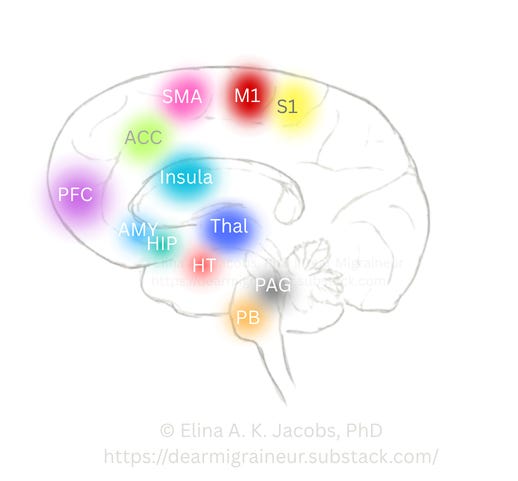
The current concensus is that the subjective experience of pain is created through a distributed neural network that spans many brain regions. While this tells us that pain really is important information for the brain, it does also make the lives of neuroscientists studying pain a lot harder. There are so many different places to look at, so many different puzzle pieces we need to try and put together to understand exactly how the brain decides to create pain.
What happens if this pain network gets activated in the absence of pain signals from the body?
Can this even happen?
Fantastic question, once again.
Yes, it seems that this is exactly what happens in some chronic pain issues. Here’s the thing: everything you experience is a creation by your brain - for a really cool video demonstrating this principle, see here.
For the longest time, people have been baffled that pain would persist after an injury has healed, or that pain appears without an apparent injury or problem in first place. It seems, for reasons we don’t fully understand yet, that under some unfortunate circumstances, the brain can get stuck in “pain on” mode, and it no longer appropriately responds to the (lack of) signals from the body that should tell it that there is no danger from an injury.
But if the brain creates a pain signature… you’ll feel pain. And that pain is just as real as any other pain you’ve ever felt in your life, and deserves to be taken just as seriously.
Unfortunately though, it is a lot harder to treat than an actual. That never justifies having your pain dismissed though. But this does require working with the brain, trying to teach it to get out of the “pain on” loop and that can be very tricky. Spoiler alert: no, you can’t simply think your way out of it; if that worked you’d have discovered that a long time ago. If you go back to the brain schema I shared, pay attention to the bit labelled PFC - that’s the main seat of your thinking brain. As you can see, it’s only a small part of the brain and there are many other brain areas involved in pain. Changing the activity of the pain network is not impossible though - I’ll cover how this can happen in a future post.
Alright, phew, we’ve come to the end.
I know this was quite a ride, but I sincerely hope that you’ve found this information helpful. If anything is unclear, please pop your questions into the comments - I promise I’ll get back to you, and potentially modify this article if it seems more clarifications are needed.
This article is free as I believe that money should not stand in the way of important information like this. If you’d like to support my efforts, you can buy me a coffee (which in fact also helps with my migraine management) ☕
Want to know more about what this Substack offers?

References
Most of what I covered can be found in introductory Neuroscience textbooks. For example:
Neuroscience: Exploring the brain, by Mark Bears, Barry Connors, Michael A. Paradiso (Jones & Bartlett Learning)
Principles of Neural Science, by Eric R. Kandel, John D. Koester, Sarah H. Mack, Steven A. Siegelbaum (McGraw Hill)
From Neuron to Brain, by John G. Nicholls, A. Robert Martin, Bruce G. Wallace, Paul A. Fuchs (Sinauer Associates)
The insights about chronic pain coming from neural circuits “getting stuck” in “pain mode” comes from newer research, here are some recent reviews:
This provides a comprehensive general overview, freely available here:
Neurophysiology of acute and chronic pain: from genes to pain symptoms
Poisbeau P & Salvat E (2025), BJA EducationA review focusing on the pain circuits within the brainstem that seem to be at the core of the changes that lead to the ‘pain mode’ getting ‘stuck’, available here:
Brainstem Pain-Modulation Circuitry and Its Plasticity in Neuropathic Pain: Insights From Human Brain Imaging Investigations
Mills EP, Keay KA & Henderson LA (2021), Frontiers in Pain ResearchResearch showing how widely distributed pain signals are in the brain (here, specifically in the cortex, the wrinkly top layer of the brain), accessible here:
Pain networks from the inside: Spatiotemporal analysis of brain responses leading from nociception to conscious perception
Bastuji H, Frot M, Perchet C, Magnin M & Garcia-Larrea L (2016), Human Brain Mapping
I have also read the book “The Way Out: The Revolutionary, Scientifically-Proven Approach to Heal Chronic Pain” by Alan Gordon - and while I’m not a huge fan of the “scientifically-proven” part in the title, it is a very evidence-based book. From what I remember, some of the language can be a bit technical, but I have also heard from non-scientists that they benefitted from reading it. I believe Pain-Reprocessing-Therapy, which I think is also gaining traction amongst migraineurs, is based on the same science and methodology as is covered in this book. I am planning on re-reading it, and writing a full book review.
Yes, this is a real thing. We’ll get back to this later.
This, in fact, plays a majour role in migraine pain.
The exception to this are cranial nerves, which connect directly to the brain rather than the spinal chord.
If you’re curious how the lock & key analogy works here, it is as follows:
The nerve endings in the muscles have locks for whom stretch acts as a key. (There is a bit more to this as well, but this isn’t supposed to be a comprehensive overview of how nerves work.)
The nerve endings in the tendons actually sit at the junction between the tendon and the muscle itself. Stretch acts as a key here as well, but because they sit between the tendon and the muscle, they only ever get stretched when the muscle contracts, because it is the contraction that will lengthen the tendon. (In contrast, the nerve endings within the muscles themselves get stretched when the actual muscle stretches.)
And in the joints, mechanical pressure acts as the key. Joints are the structures where bones meet, and bones being in different positions towards each other creates different kinds of pressure.
Fun fact: the vestibular and auditory nerve actually form two branches of the 8th cranial nerve, also called the vestibulocochlear nerve.
Hormones are signals carried around the body through blood circulation.
Note that this is not meant to be a literal explanation of how this occurs at the molecular level - there is no physical lubrication or promiscuity going on. This is meant as a conceptual metaphor - the effects of what’s happening are akin to that. For a more detailed introduction to the molecular biology of receptors, see Maria Bergsland’s excellent writing.
Scientists call this peripheral hyperalgesia.
Heavy emphasis on part of the reason - migraine pathology is much more complex than this.
I’m anthropomorphising the brain here, I know. Bear with me for a second, it’s all for explanatory purposes - and no, the brain, as far as we know, does not have a secondary subjective experience but it all seems to be an emergent property of various different neural circuits humming along, doing their thing, processing information, most of it happening under the hood.
There aren’t that many of us systems neuroscientists talking about the brain publicly. Most of what you’ve come across I suspect is from cognitive neuroscientists - the ones who have the pretty pictures of different brain areas lighting up.
Fun fact: we’ve had evidence for this for decades, that for example there are cells in the visual cortex that responding to sounds, but people were so convinced that this was impossible and that the visual cortex only deals with vision that these results were often called errors and artefacts - in short, not real. But now we have newer methodology that has allowed us to pretty irrefutably show that these signals are indeed very real: and it’s a pattern that occurs across the brain. This is what systems neuroscientists do: we like to have cellular level resolution of the networks & systems we’re investigating. We have tools to light up individual, genetically identifiable, living (!) brain cells inside living animals, or electrically record the activity of hundreds of different brain cells simultaneousy, again in living behaving animals. (And yes, I miss that work, it’s awesome.) I was part of the lab that produced these papers:
Steinmetz NA, Zatka-Haas P, Carandini M, Harris KD. Distributed coding of choice, action and engagement across the mouse brain. Nature. 2019 Dec;576(7786):266-273. doi: 10.1038/s41586-019-1787-x.
Okun M, Steinmetz N, Cossell L, Iacaruso MF, Ko H, Barthó P, Moore T, Hofer SB, Mrsic-Flogel TD, Carandini M, Harris KD. Diverse coupling of neurons to populations in sensory cortex. Nature. 2015 May 28;521(7553):511-515. doi: 10.1038/nature14273.
Stringer C, Pachitariu M, Steinmetz N, Reddy CB, Carandini M, Harris KD. Spontaneous behaviors drive multidimensional, brainwide activity. Science. 2019 Apr 19;364(6437):255. doi: 10.1126/science.aav7893.
International Brain Laboratory; Angelaki D, Benson B, Benson J, Birman D, Bonacchi N, Bougrova K, Bruijns SA, Carandini M, Catarino JA, Chapuis GA, Churchland AK, Dan Y, Davatolhagh F, Dayan P, DeWitt EE, Engel TA, Fabbri M, Faulkner M, Fiete IR, Findling C, Freitas-Silva L, Gerçek B, Harris KD, Häusser M, Hofer SB, Hu F, Hubert F, Huntenburg JM, Khanal A, Krasniak CS, Langdon C, Langfield C, Lau PYP, Mainen ZF, Meijer GT, Miska NJ, Mrsic-Flogel TD, Noel JP, Nylund K, Pan-Vazquez A, Paninski L, Pouget A, Rossant C, Roth N, Schaeffer R, Schartner M, Shi Y, Socha KZ, Steinmetz NA, Svoboda K, Urai AE, Wells MJ, West SJ, Whiteway MR, Winter O, Witten IB. A brain-wide map of neural activity during complex behaviour. Nature. 2025 Sep;645(8079):177-191. doi: 10.1038/s41586-025-09235-0.
The outermost part of the brain that looks wrinkly and a bit like a walnut.
I will be thinking about this one for a long time. So validating and also so helpful in giving me the language to discuss my pain with people I love. Thank you for writing this!!
A great piece on pain. Thank you!